
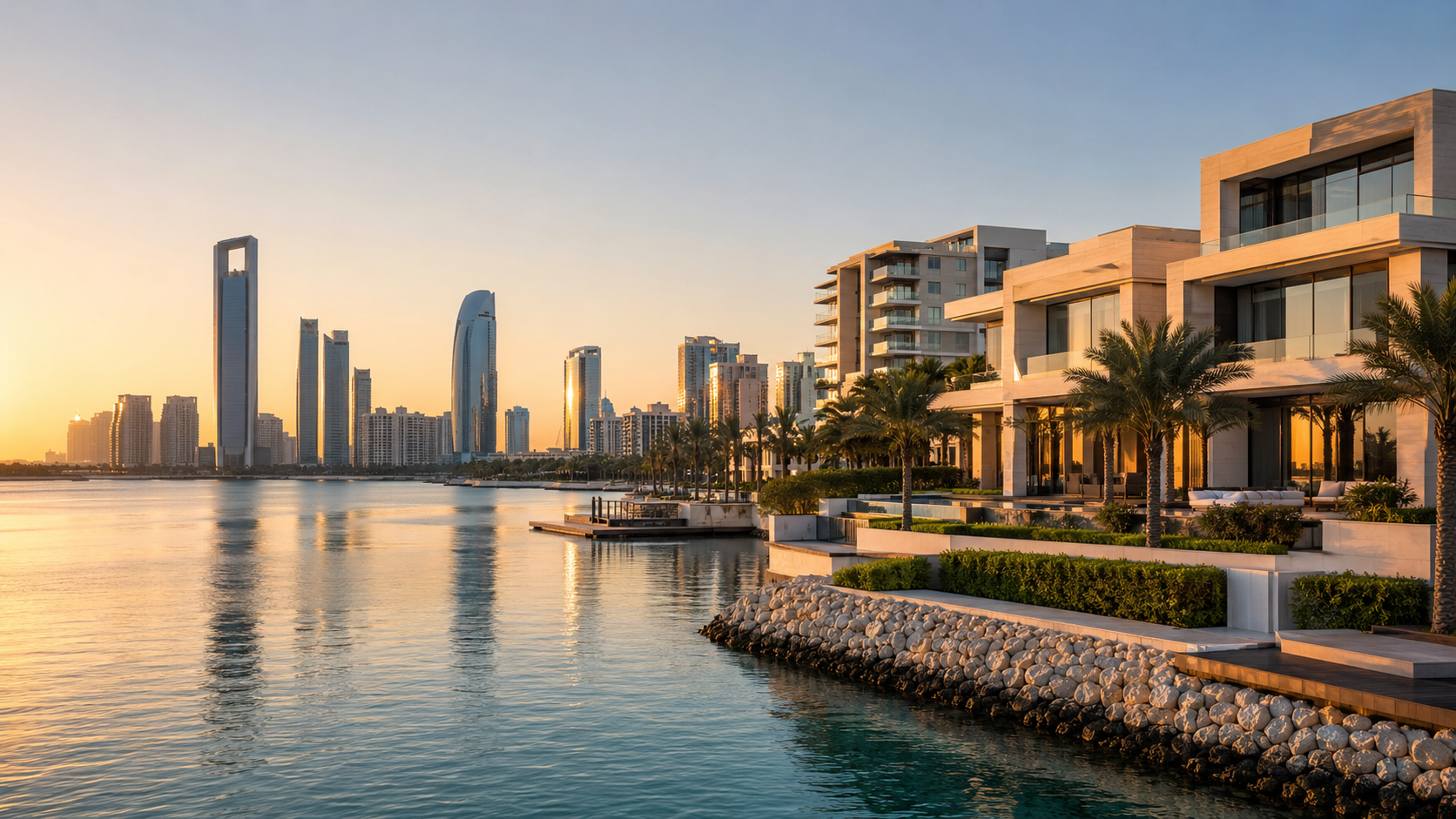
Abu Dhabi’s real estate market has entered a new phase of maturity.
For many years, the emirate was viewed primarily as a stable, income-oriented alternative to Dubai—less speculative, more measured and largely driven by domestic demand. That description is no longer sufficient. Abu Dhabi is now attracting a broader international investor base, delivering record transaction volumes and expanding the number of locations in which foreign buyers can own property.
The figures confirm the scale of this shift. According to the Abu Dhabi Real Estate Centre, total real estate transactions reached AED117 billion during the first half of 2026. This represented a 112% increase in value and a 61.7% increase in transaction volume compared with the corresponding period of 2025. Foreign direct investment also rose significantly, reaching AED13.8 billion in six months—more than the amount recorded during the whole of 2025.
Yet strong headline numbers do not mean that every project, property type or location will perform equally well.
For investors, the important question is not simply whether Abu Dhabi’s market is growing. It is where that growth is coming from, how sustainable it may be and which properties are best aligned with a buyer’s financial objectives.
This Abu Dhabi real estate market update examines the forces shaping the emirate in 2026, the locations attracting attention and the factors buyers should consider before entering the market.
Abu Dhabi’s Property Market at a Glance
The first half of 2026 produced several notable indicators:
- Total real estate transactions reached AED117 billion.
- Transaction value increased by 112% year on year.
- Transaction volume increased by 61.7%.
- Sales transactions accounted for AED86.1 billion across 16,838 deals.
- Mortgage transactions reached AED26.7 billion across 8,876 deals.
- Foreign direct investment increased by 309% to AED13.8 billion.
- Non-resident investors from 116 nationalities participated in the market.
- Eight new investment zones were approved, bringing Abu Dhabi’s total to 50.
- Twenty-eight new real estate projects were registered during the period.
These figures demonstrate more than a temporary rise in activity. They point to a market becoming deeper, more internationally connected and more diverse in its available investment options.
The increasing contribution of mortgages is particularly relevant. A functioning mortgage market indicates that activity is not based exclusively on cash purchases or short-term off-plan reservations. Financing helps broaden the buyer base and can support a more sustainable resale market.
International participation is also becoming more diverse. Investors from the United Kingdom, China, Russia, the United States, Germany and France were among the leading sources of foreign real estate investment during the first half of 2026. This reduces the market’s dependence on a narrow group of buyers and gives Abu Dhabi greater visibility as a global investment destination.
Why Is Abu Dhabi Real Estate Growing?
No single factor explains the market’s performance. The current cycle is supported by a combination of economic growth, population expansion, regulatory development, infrastructure investment and a stronger supply of internationally marketable properties.
1. A Growing and Diversifying Economy
Abu Dhabi remains one of the world’s most financially secure capitals, but its property market is increasingly supported by industries beyond oil and gas.
The emirate continues to invest in finance, technology, tourism, logistics, culture, healthcare, education and advanced manufacturing. This diversification matters to property investors because economic activity creates employment, attracts specialist talent and increases demand for both owned and rented homes.
During the third quarter of 2025, Abu Dhabi’s economy expanded by 7.7% year on year, while its non-oil economy grew by 7.6%. The real estate sector itself expanded by 13.1% and contributed AED12.1 billion to the economy during the quarter.
A diversified economy can help create more durable housing demand. Instead of relying on a single industry or buyer segment, Abu Dhabi is developing several interconnected sources of residential and commercial activity.
2. Strong Population Growth
Population growth is one of the most important long-term drivers of residential real estate.
Abu Dhabi’s population reached approximately 4.14 million in 2024, representing annual growth of 7.5%, according to the Statistics Centre – Abu Dhabi. New residents require housing at different price points, from efficient apartments near employment centres to family villas, waterfront homes and luxury residences.
Population growth does not automatically guarantee investment success. New supply must also be considered. Nevertheless, a growing resident base strengthens the underlying demand required to support occupancy, rental activity and resale liquidity.
For investors, the key is to identify communities where new housing is accompanied by employment access, schools, leisure facilities, transport links and everyday services. Properties in complete or rapidly maturing communities tend to appeal to a wider tenant and buyer pool than isolated developments.
3. Wider Access for International Investors
Abu Dhabi has progressively expanded the areas in which foreign nationals may acquire property.
Eight new investment zones were approved during the first half of 2026, taking the emirate’s total to 50. This gives international buyers a broader selection of locations, developers, property types and price points.
The expansion of investment zones is important because it moves Abu Dhabi away from a market concentrated in only a handful of internationally accessible communities. It also gives emerging districts the potential to attract new capital and develop more active secondary markets.
However, buyers should still confirm the precise ownership structure, title rights and registration requirements applicable to any property. The presence of an investment zone does not eliminate the need for legal and commercial due diligence.
4. Greater Market Transparency
Abu Dhabi has continued to strengthen the regulation and presentation of its property market.
The Abu Dhabi Real Estate Centre has introduced measures intended to improve the quality of market data, professional licensing and real estate advertising. Its Madhmoun platform had facilitated more than 41,200 regulated advertising permits by the end of the first half of 2026.
This matters because property investors depend on accurate information. Clearer advertising rules and more reliable listing data can make it easier to compare properties, identify realistic asking prices and avoid duplicate or misleading advertisements.
Transparency does not remove investment risk, but it improves the quality of the decisions investors can make.
The Abu Dhabi Locations Attracting Investor Attention
Abu Dhabi is not a single, uniform property market. Each community has a different proposition, tenant profile, supply pipeline and investment horizon.
Four locations stood out in official transaction data for the first quarter of 2026.
Hudayriyat Island
Hudayriyat Island recorded approximately AED11.97 billion in transactions during the first quarter of 2026, making it the leading location by transaction value for the period.
The island’s proposition is closely connected to low-density living, premium residences, waterfront access and a lifestyle built around sport, recreation and wellness. Its large-scale development plans have positioned it as one of Abu Dhabi’s most closely watched emerging destinations.
For investors, Hudayriyat may offer exposure to the creation of a new premium district rather than an already mature community. That can provide capital-growth potential, but it also introduces development and timing considerations.
Buyers should examine construction milestones, future supply, community phasing and the intended end-user profile. The right property may benefit as the destination matures, but investors should use a sufficiently long holding period and avoid relying exclusively on short-term price appreciation.
Al Reem Island
Al Reem Island recorded approximately AED9.45 billion in transactions during the first quarter of 2026.
Unlike newer destinations, Reem Island is already an established residential district with completed buildings, schools, shops, offices and direct access to central Abu Dhabi. It offers a wide range of apartments, from accessible investment units to larger waterfront and branded residences.
This variety can make Reem Island attractive to investors seeking rental demand and secondary-market liquidity. It also means performance can vary significantly from one building to another.
Two apartments with similar sizes may achieve very different rents or resale prices depending on their developer, age, maintenance, service charges, layout, view and building management. A successful investment on Reem Island therefore requires building-level analysis, not merely confidence in the wider location.
Saadiyat Island
Saadiyat Island generated approximately AED8.8 billion in transactions during the first quarter of 2026.
Its appeal is distinctive. Saadiyat combines beaches, cultural institutions, educational facilities and a limited collection of premium residential communities. This gives the island an international identity that few regional destinations can replicate.
The island is especially relevant to buyers seeking luxury villas, beachfront apartments and residences near Abu Dhabi’s cultural district. Its long-term value proposition is connected not only to property quality but also to scarcity, placemaking and global recognition.
Investors considering Saadiyat should distinguish between lifestyle-led acquisitions and yield-led investments. Prime homes may command a premium because of their location and exclusivity, even when their percentage rental yield is lower than that of a smaller apartment elsewhere. For many high-net-worth buyers, capital preservation, quality of life and long-term scarcity are equally important considerations.
Yas Island
Yas Island recorded more than AED5.5 billion in transactions during the first quarter of 2026.
The island is one of Abu Dhabi’s most established leisure and entertainment destinations, supported by attractions, hotels, retail, schools, beaches and major events. Its residential market serves a broad audience that includes professionals, families, investors and holiday-home buyers.
Yas Island’s diversity is one of its strengths. Buyers can consider apartments, townhouses and villas across completed and off-plan communities. Demand can be supported by both long-term residents and the island’s growing profile as an international destination.
The principal consideration is property selection. Investors should compare the supply pipeline, handover schedule and likely tenant profile of each development. A project designed primarily for short stays may perform differently from a family community intended for permanent residents.
Off-Plan or Ready Property in Abu Dhabi?
Both segments offer genuine opportunities, but they serve different objectives.
The Case for Off-Plan Property
Off-plan properties can provide:
- Staged payment plans
- Access to newly launched communities
- Lower initial capital requirements
- Contemporary layouts and amenities
- Potential appreciation before or after completion
They may suit buyers who have a longer investment horizon and do not require immediate rental income.
However, investors must evaluate more than the launch price. Developer quality, construction progress, payment obligations, unit selection and the volume of competing supply all influence the final outcome. Attractive marketing cannot compensate for weak fundamentals.
The Case for Ready Property
Completed properties can provide:
- Immediate rental income
- Physical inspection before purchase
- Evidence of actual building quality
- Observable service charges
- Comparable rental and resale transactions
- Lower construction and delivery uncertainty
They may suit investors prioritising income, certainty or a shorter route to occupancy.
The trade-off is that the buyer may need to provide more capital at the time of purchase, and a mature property may offer less dramatic payment flexibility than a new launch.
The best choice depends on the investor’s objective. A buyer seeking immediate cash flow should not evaluate a three-year off-plan opportunity in the same way as a completed, tenanted apartment. Similarly, a buyer targeting long-term capital growth in an emerging district may reasonably accept a delayed income period.
What Is Happening in Abu Dhabi’s Luxury Segment?
Luxury real estate in Abu Dhabi is becoming more internationally relevant.
The emirate offers a combination that is increasingly attractive to affluent buyers: waterfront living, low-density communities, political and economic stability, high-quality infrastructure and access to a tax-efficient environment.
Demand is not limited to conventional investment calculations. Luxury buyers often consider privacy, architecture, beach access, views, plot size, brand association and the quality of the surrounding community. These qualities can be difficult to reproduce, which may support the long-term value of genuinely scarce properties.
That said, the word “luxury” is widely used. A high price or impressive lobby does not automatically make a residence a strong luxury asset.
Buyers should ask:
- Is the location genuinely scarce?
- Is the view protected or could future construction affect it?
- Who developed and operates the property?
- Are the materials and specifications consistent with the asking price?
- Are the service charges justified?
- Is the layout suitable for the intended end user?
- How much competing supply is planned nearby?
- Will the property remain desirable after newer projects enter the market?
In the premium segment, small details have a disproportionate influence on value. Floor height, orientation, privacy, internal circulation, terrace depth and proximity to amenities can determine whether a property is easy or difficult to resell.
Opportunities for Investors in 2026
The current market presents several potential strategies.
Income-Producing Apartments
Completed apartments in established communities may suit buyers seeking rental income and easier access to market evidence.
The strongest opportunities are not necessarily the cheapest units. Investors should focus on the relationship between acquisition cost, realistic annual rent, service charges, maintenance, vacancy expectations and transaction expenses.
Net yield matters more than an advertised gross yield.
Family Townhouses and Villas
Population growth and the arrival of professional families can support demand for well-located townhouses and villas near schools, parks, retail and employment centres.
These properties may have a broader end-user appeal and can benefit from longer tenancies. Their total entry price is higher, however, and maintenance obligations should be incorporated into the investment calculation.
Prime Waterfront and Branded Residences
Waterfront and branded properties may appeal to international buyers prioritising quality, scarcity and capital preservation.
The brand alone should not determine the purchase. The operator, management agreement, service-charge structure and depth of resale demand all require careful review.
Early-Stage Master-Planned Communities
Emerging destinations may offer stronger long-term appreciation if infrastructure, amenities and population arrive as planned.
This strategy requires patience. Investors should understand what will be delivered, when it is expected and how many competing units may enter the market at the same time.
Risks Investors Should Not Ignore
Strong market performance can create a sense of urgency, but disciplined investors remain selective.
Future Supply
New project launches expand choice but can also create competition. A large number of similar units completing within a short period may affect rents, occupancy and resale pricing.
Supply should be evaluated at community, project and unit-type level.
Service Charges and Ownership Costs
A property’s purchase price is only part of its financial profile. Service charges, maintenance, agency fees, registration expenses, financing costs and vacancy periods can materially affect returns.
Luxury amenities are valuable only when their cost is proportionate to the value they create for owners and tenants.
Interest Rates and Financing
Mortgage conditions influence both purchasing power and resale demand. Leveraged buyers should stress-test repayments and avoid assuming that financing conditions will always become more favourable.
Developer and Delivery Risk
For off-plan investments, the developer’s experience and record of delivery matter. Buyers should review the project documentation, escrow arrangements, construction schedule and contractual terms before committing.
Paying for the Wrong Unit
Even in a strong project, not every unit is equally attractive.
An inefficient layout, compromised view, excessive road noise or weak position within the building can limit rental and resale demand. Unit selection is one of the most important—and most frequently underestimated—parts of the buying process.
Is 2026 a Good Time to Buy Abu Dhabi Property?
For a properly prepared buyer, 2026 may offer compelling opportunities. The market is benefiting from stronger international participation, population growth, economic diversification and continued development across established and emerging communities.
However, the record level of activity should not be interpreted as a reason to buy indiscriminately.
A sensible decision begins with five questions:
- Is the objective rental income, capital growth, personal use or a combination?
- What is the intended holding period?
- How much liquidity will remain after the purchase?
- Is a completed or off-plan property better suited to the objective?
- What evidence supports the chosen location, project and unit?
The strongest investment is not always the development receiving the most attention. It is the property whose price, quality, location and timeline align with the buyer’s individual strategy.
The Outlook for Abu Dhabi Real Estate
Abu Dhabi enters the second half of 2026 with considerable momentum. Record transaction activity, a sharp increase in foreign investment and the continued expansion of investment zones have strengthened the emirate’s international position.
The broader foundations also remain meaningful. Economic diversification is creating employment and business activity. Population growth is supporting housing demand. New cultural, leisure and infrastructure projects are improving the appeal of individual destinations. Regulation and market data are becoming more sophisticated.
The next stage of the cycle is likely to reward selectivity.
Established communities may continue to attract buyers looking for income and liquidity. Prime islands may appeal to purchasers seeking scarcity and lifestyle value. Emerging destinations may offer long-term growth, provided their development plans translate into completed infrastructure and genuine end-user demand.
In this environment, informed advice becomes more valuable—not less. A rising market can conceal important differences between projects, buildings and individual units. Buyers who examine the fundamentals will be better positioned than those responding only to launch activity or headline growth figures.
A More Considered Way to Invest
Abu Dhabi’s property market now offers opportunities across a wide range of budgets and investment strategies. Choosing among them requires more than a list of available properties. It requires a clear understanding of the buyer’s objectives, the market cycle and the qualities that will protect a property’s appeal over time.
Homam Assad provides tailored real estate guidance for buyers and investors considering off-plan, resale and premium properties across Abu Dhabi and the wider UAE.
Whether you are evaluating a waterfront residence, an income-producing apartment or an early-stage investment opportunity, the process should begin with a strategy—not a sales pitch.
Visit HomamAssad.com to discuss your requirements and identify properties aligned with your lifestyle, budget and long-term investment goals.
Disclaimer: This article is provided for general informational purposes and does not constitute legal, tax or financial advice. Market conditions, project details, regulations and investment returns can change. Buyers should complete independent due diligence and obtain appropriate professional advice before making a property decision.



Join The Discussion