
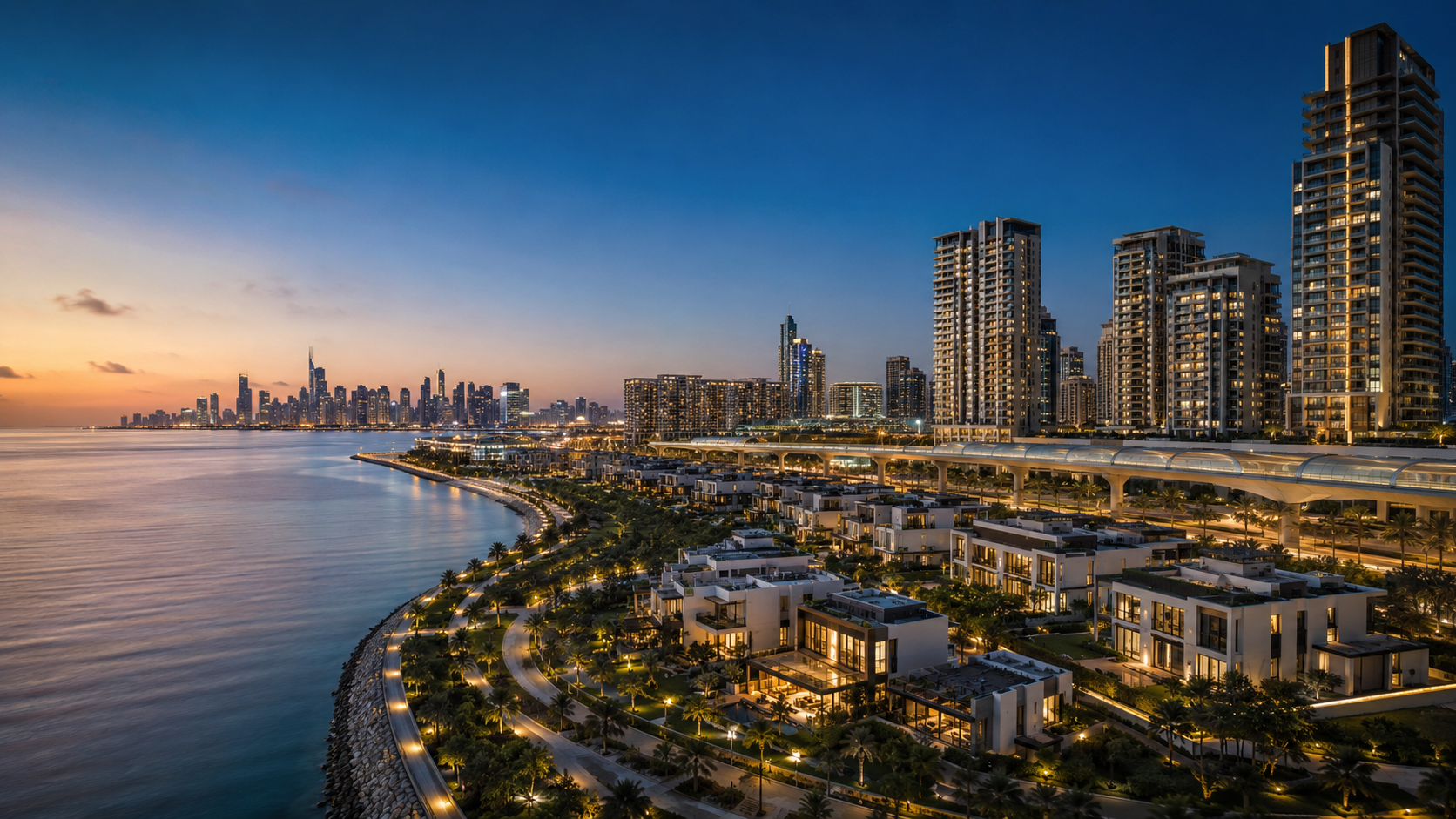
The UAE property market entered 2026 with considerable momentum.
Dubai completed its strongest real estate year on record in 2025, while Abu Dhabi reported a sharp increase in transaction value and foreign investment during the first half of 2026. New residential communities, expanding tourism infrastructure and a growing international buyer base continue to support activity across both emirates.
The market is also becoming more sophisticated.
Buyers are examining developer reputation, community quality, service charges and long-term operating costs more carefully. Regulators are strengthening data, advertising and transaction systems. Sustainability, branded residences and digital ownership models are becoming increasingly visible.
These trends create opportunities, but they also require selectivity.
A strong national market does not mean that every development, community or unit will deliver the same result. Investors must distinguish between genuine end-user demand and temporary launch activity, between defensible scarcity and expensive marketing, and between a manageable payment plan and a well-priced asset.
This UAE real estate trends report examines the forces likely to shape the market in 2026 and beyond, with a particular focus on Abu Dhabi and Dubai.
UAE Property Market Overview
Dubai recorded more than 270,000 real estate transactions worth approximately AED917 billion in 2025, according to the Dubai Media Office. This represented a 20% annual increase in transaction value.
Momentum continued into 2026. During the first quarter, Dubai recorded AED252 billion in real estate transactions, representing a 31% increase in value compared with the same period of 2025. Real estate investments reached AED173 billion across 57,744 transactions.
Abu Dhabi also experienced significant growth.
The Abu Dhabi Real Estate Centre reported that total transaction value reached AED117 billion during the first half of 2026. This represented a 112% annual increase, while transaction volume rose by 61.7%.
Foreign direct investment in Abu Dhabi real estate reached AED13.8 billion during the six-month period, increasing by 309% and exceeding the total recorded during the whole of 2025.
These figures reveal two large markets with different but complementary strengths.
Dubai offers international visibility, extensive transaction liquidity and a highly active off-plan sector. Abu Dhabi offers economic stability, expanding foreign-ownership opportunities and a growing collection of cultural, waterfront and master-planned destinations.
Trend 1: International Investment Is Becoming More Diverse
International buyers have long played an important role in the UAE property market. In 2026, the scale and diversity of that participation remain central to growth.
Dubai recorded AED148.35 billion in foreign real estate investment during the first quarter of 2026, an increase of 26%. Its total investor base grew to 48,448 during the quarter, including 29,312 new investors.
In Abu Dhabi, non-resident buyers from 116 nationalities participated in the property market during the first half of 2026. The United Kingdom, China, Russia, the United States, Germany and France ranked among the leading sources of foreign direct investment.
A wider buyer base can strengthen market resilience. If demand comes from several regions and investment profiles, the market is less dependent on one source of capital.
International demand is supported by several factors:
- Economic and political stability
- Global flight connectivity
- A business-friendly environment
- Foreign-ownership opportunities
- High-quality infrastructure
- Lifestyle and personal-safety considerations
- Long-term residency options for eligible investors
- A wide range of property prices and types
However, international demand can be sensitive to currency movements, global interest rates and economic conditions in buyers’ home markets.
Investors should avoid assuming that foreign capital will support every price point equally. International purchasers tend to be highly selective, particularly in the premium segment.
Trend 2: Abu Dhabi Is Moving Further into the Global Market
Abu Dhabi has historically been regarded as a more measured property market than Dubai. That remains part of its appeal, but the emirate’s international profile is changing.
Eight new investment zones were approved during the first half of 2026, bringing Abu Dhabi’s total to 50. Twenty-eight new real estate projects were registered over the same period.
The expansion of investment zones gives foreign buyers access to a broader selection of communities and property types. It also reduces concentration in a small number of established areas.
Several destinations are attracting particular attention:
- Hudayriyat Island
- Al Reem Island
- Saadiyat Island
- Yas Island
- Al Raha Beach
- Al Maryah Island
- Emerging waterfront and villa communities
Hudayriyat, Reem, Saadiyat and Yas were among the leading locations by transaction value during the first quarter of 2026.
Abu Dhabi’s growth is supported by more than residential development. The emirate is investing in tourism, culture, finance, technology, manufacturing, education and healthcare. These sectors create employment and support housing demand.
The strongest opportunities are likely to be located where economic growth, infrastructure and genuine community development intersect.
Trend 3: Dubai Is Prioritising Scale and Market Maturity
Dubai’s property market continues to grow in both transaction value and institutional sophistication.
The emirate recorded AED917 billion in real estate transactions during 2025. During the same year, the number of sold units increased by 25% to approximately 147,500, with a combined value of AED280 billion.
The number of projects under construction increased by 25% to 937.
This pipeline demonstrates developer confidence, but it also represents one of the most important issues investors must monitor.
A large development pipeline can provide:
- More choice
- New communities
- Improved infrastructure
- Modern property specifications
- More accessible payment plans
- Opportunities at different price points
It can also produce competition at handover.
If many similar apartments complete within the same area and period, owners may compete for tenants and buyers. Units with weak layouts, poor views or excessive launch premiums are most vulnerable.
Dubai’s next stage will likely reward building-level and unit-level analysis rather than broad confidence in the city alone.
Trend 4: Off-Plan Property Remains a Major Market Driver
Off-plan development remains one of the defining features of the UAE property market.
Buyers are attracted by:
- Staged payment plans
- Lower immediate capital requirements
- Access to new communities
- Contemporary design
- Early unit selection
- Potential appreciation during construction
Developers have also introduced increasingly varied payment structures, including construction-linked schedules and post-handover instalments.
The strength of the off-plan sector does not mean that every launch represents good value.
Investors should compare:
- Launch price with completed alternatives
- Price per square foot or square metre
- Developer delivery record
- Future supply
- Community maturity
- Payment obligations
- Expected service charges
- Realistic rent at completion
- Assignment restrictions
- Handover timing
A long payment plan can make a high price appear manageable. Buyers should separate payment convenience from asset value.
Regulation and escrow systems provide important safeguards. In Abu Dhabi, off-plan sales are registered through ADREC and buyer payments are held in project-specific regulated escrow accounts. Dubai also requires off-plan developers to use project escrow accounts and record initial sales with the Dubai Land Department.
These systems improve transparency but do not guarantee construction timing, capital appreciation or rental performance.
Trend 5: Ready Properties Are Regaining Strategic Importance
As off-plan prices rise and construction pipelines expand, completed properties can provide an increasingly useful comparison.
Ready properties offer:
- Immediate occupancy
- Immediate rental potential
- Physical inspection
- Established service charges
- Observable building quality
- Actual rental and resale evidence
- Greater mortgage accessibility
In some communities, a ready property may be priced close to—or below—a comparable off-plan unit.
This can create opportunities for investors who prioritise income or certainty.
A completed property may also be improved through renovation, furnishing or better management. In mature communities, a carefully upgraded property can differentiate itself from standard competing stock.
Investors should still examine maintenance, building age, tenancy status and service charges. Ready property removes construction risk but introduces physical-condition and management considerations.
Trend 6: Luxury Real Estate Is Broadening
Luxury property remains one of the UAE market’s most visible segments.
Dubai recorded AED87.71 billion in luxury real estate investment during the first quarter of 2026, an increase of 26%.
The luxury market is also expanding beyond conventional villas and penthouses. Buyers can now consider:
- Branded residences
- Waterfront mansions
- Resort-integrated homes
- Serviced apartments
- Golf-course villas
- Private-island properties
- Low-density wellness communities
- Architect-designed residences
Abu Dhabi is developing its own distinct luxury proposition through Saadiyat Island, Hudayriyat Island, Yas Island and other premium waterfront districts.
The strongest luxury assets tend to offer genuine scarcity.
This may include:
- Protected waterfront views
- Direct beach access
- Large plots
- Limited collections
- Exceptional privacy
- Recognised design or operation
- Prime cultural or resort locations
- High construction quality
The term “luxury” is widely used in property marketing. Buyers should evaluate the asset beyond its branding.
A high price, elaborate lobby or long list of amenities does not automatically create long-term luxury value. Design quality, management, privacy, scarcity and resale demand are more important.
Trend 7: Branded Residences Are Becoming More Prominent
The UAE has become one of the world’s most active markets for branded residences.
These properties associate a residential development with a hospitality, fashion, automotive or design brand. They may include services, furnished interiors and professional management.
Branded residences can provide:
- Global buyer recognition
- Service-led living
- Design consistency
- International marketing
- Prestige
- Potential resale differentiation
The brand premium requires careful analysis.
Investors should ask:
- What role does the brand actually perform?
- Who operates the property?
- What services are included?
- What are the annual charges?
- Are there owner-use restrictions?
- Is participation in a rental programme required?
- How does the price compare with nearby non-branded properties?
- Will the brand remain involved over the long term?
A branded residence can be a strong asset when the partnership delivers meaningful quality and service. The name alone is not sufficient.
Trend 8: Family Communities and Villas Remain in Demand
Buyer preferences continue to support villas, townhouses and integrated family communities.
Dubai’s 2025 data showed that the value of sold villas increased despite a decline in transaction volume, indicating continued demand for higher-value residential products.
In Abu Dhabi, new villa communities are expanding across destinations such as Yas Island, Saadiyat Island and Hudayriyat Island.
Family buyers frequently prioritise:
- Schools and nurseries
- Parks and open space
- Privacy
- Storage
- Larger internal areas
- Community retail
- Road access
- Healthcare
- Long-term liveability
These preferences can support longer tenancies and end-user demand.
However, villa ownership involves higher maintenance and a larger total investment. Plot position, landscaping, construction quality and community completion significantly influence performance.
Investors should compare total acquisition and ownership costs rather than focusing only on price per square metre.
Trend 9: Tourism and Entertainment Are Shaping Property Demand
The UAE continues to invest in tourism, hospitality and entertainment.
Yas Island received more than 38 million visits in 2024. Its expanding attractions and the planned Disney theme park resort may further strengthen Abu Dhabi’s tourism economy over the long term.
Dubai continues to expand its hospitality, events and leisure ecosystem, supporting demand for hotels, holiday homes and serviced residences.
Tourism can influence property markets by:
- Creating employment
- Increasing destination awareness
- Supporting retail and restaurants
- Attracting second-home buyers
- Generating short-term accommodation demand
- Encouraging infrastructure investment
Investors should not assume that high visitor numbers guarantee profitable short-term rentals.
Holiday-home performance depends on location, seasonality, furnishing, management, licensing and operating costs. Net returns can be significantly lower than gross nightly-rate projections.
Trend 10: Sustainability Is Moving from Marketing to Investment Analysis
Sustainability is becoming increasingly relevant to development and property selection.
New communities are incorporating:
- Solar energy
- Efficient cooling
- Water management
- Shaded public spaces
- Walkability
- Cycling infrastructure
- Greener landscaping
- Electric-vehicle charging
- Smart-home systems
These features can improve resident comfort and potentially reduce certain operating costs.
Investors should look for measurable performance rather than general sustainability claims.
Important questions include:
- Does the design reduce energy consumption?
- Are service charges competitive?
- How is landscaping maintained?
- Are the public spaces usable throughout the year?
- Is the property certified under a recognised standard?
- Do sustainable systems reduce costs for residents?
- Will the development remain attractive as regulations and buyer expectations evolve?
A genuinely efficient building may have a long-term advantage over an older or poorly managed alternative.
Trend 11: Property Technology and Tokenisation Are Advancing
Digital platforms are changing how UAE real estate is marketed, registered and managed.
Abu Dhabi has expanded the use of ADREC and DARI for registration, project information and transaction services. The Madhmoun system regulates real estate advertising permits and seeks to improve listing quality.
Dubai provides transaction data and project information through the Dubai Land Department and Dubai REST.
Dubai has also launched a real estate tokenisation initiative. The Dubai Land Department has stated that the tokenised real estate market could reach AED60 billion by 2033, representing an estimated 7% of transactions.
Tokenisation may eventually allow investors to purchase smaller economic interests in property through regulated digital structures.
Potential benefits include:
- Lower investment thresholds
- Fractional participation
- Digital settlement
- Wider investor access
- Improved transaction efficiency
The segment is still developing. Investors should understand the legal ownership structure, liquidity, platform regulation, fees and rights attached to any tokenised interest.
Owning a token linked to property may not provide the same rights as holding a registered title deed.
Trend 12: Data and Advertising Transparency Are Improving
The quality of market information is becoming a competitive priority.
Buyers have historically faced duplicate listings, unavailable properties and inconsistent pricing. Regulatory platforms are increasingly addressing these issues through permits, professional licensing and verified data.
Greater transparency allows investors to:
- Compare transaction values
- Verify projects
- Track construction
- Review official listings
- Confirm brokers and developers
- Check escrow arrangements
- Assess rental evidence
Access to data does not automatically produce good decisions. Market statistics must be interpreted at the correct level.
Citywide growth may not describe a specific community. Community performance may not describe a particular building. Building averages may not capture the capture the advantage or weakness of an individual unit.
The most useful analysis moves from the wider market to the exact property.
Trend 13: Rental Demand Remains Strong but Affordability Matters
Population and employment growth continue to support rental demand in Abu Dhabi and Dubai.
Dubai’s rental market recorded further expansion in 2025, while Abu Dhabi reported continued growth in active leases during 2026.
Rising rents can improve owner income, but they also create affordability concerns.
If rental costs rise faster than household incomes, tenants may:
- Move to more affordable communities
- Choose smaller properties
- Negotiate longer leases
- Relocate between emirates
- Share accommodation
- Consider purchasing instead of renting
Investors should understand the target tenant’s income and alternatives.
The best rental property is not always located in the most expensive area. It is one that provides a compelling combination of price, transport, amenities and quality for a clearly defined tenant profile.
Trend 14: Infrastructure Is Creating New Investment Corridors
Infrastructure is one of the most powerful long-term property drivers.
Roads, airports, public transport, schools, cultural venues and employment centres can change how communities are valued.
The effect is rarely immediate or uniform.
Properties closest to new infrastructure may benefit from improved access, but they may also experience construction, traffic or noise. Emerging corridors may take years to develop active rental markets.
Investors should distinguish between:
- Announced infrastructure
- Funded infrastructure
- Construction underway
- Completed and operational infrastructure
A long-term investment should not depend entirely on an uncertain future project.
The Main Risks Facing UAE Property Investors
Large Development Pipelines
Future supply is one of the most important variables in both Dubai and Abu Dhabi.
Investors should study the number of comparable units expected to complete in the same area and year.
Paying a Launch Premium
Strong demand can encourage aggressive pricing. A prestigious location does not justify any purchase price.
Interest Rates and Financing
Mortgage costs influence affordability and resale demand. Leveraged buyers should test repayments under less favourable conditions.
Global Economic Conditions
Foreign buyers are affected by economic performance, currencies and financing conditions in their home countries.
Service Charges
High annual charges can reduce net yield and resale appeal. Buyers should assess the cost and practical value of amenities.
Handover Concentration
When many investors receive similar units simultaneously, competition can affect rent and resale prices.
Weak Unit Selection
An inefficient layout, obstructed view or noisy location can underperform even in a successful development.
Short Holding Periods
Transaction expenses and market cycles can make rapid resale less profitable than expected.
Where Could the Strongest Opportunities Be?
Different strategies suit different investors.
Income-Focused Investors
Completed apartments in established communities may offer clearer rental evidence and immediate income.
Capital-Growth Investors
Well-priced off-plan properties in developing master-planned communities may offer appreciation potential over a longer horizon.
Family-Housing Investors
Townhouses and villas near schools, parks and employment centres may benefit from sustained end-user demand.
Luxury Investors
Scarce waterfront homes, branded residences and limited villa collections may provide capital preservation and international appeal.
Value-Oriented Investors
Older but well-managed properties in established locations may offer renovation or repositioning opportunities.
No category is automatically superior. The acquisition price and individual asset quality remain decisive.
UAE Real Estate Outlook for the Rest of 2026
The UAE property market remains supported by strong transaction activity, foreign investment and continued development.
Dubai enters the period with considerable liquidity and international recognition. Abu Dhabi is expanding rapidly while maintaining a more measured, master-planned character.
Several themes are likely to define the remainder of 2026:
- Continued international participation
- Strong off-plan launch activity
- Greater focus on completed-property value
- Expansion of luxury and branded residences
- New family-oriented communities
- More sophisticated regulation and market data
- Increasing attention to service charges and net returns
- Long-term growth in sustainability and property technology
The market’s strength does not remove the need for caution. It increases the importance of selecting assets that can remain competitive as more supply is delivered.
Investing with a Long-Term Perspective
The UAE remains one of the world’s most dynamic property markets, but successful investing requires more than following national growth figures.
A property must work at several levels.
The emirate should provide economic and population demand. The community should offer infrastructure and liveability. The project should be well designed and managed. The individual unit should have a clear advantage. Finally, the price and payment structure must align with the investor’s financial position.
Homam Assad provides tailored guidance for buyers evaluating off-plan, resale and premium properties across Abu Dhabi and Dubai.
Whether your objective is rental income, long-term capital growth, personal use or wealth preservation, a property strategy should begin with independent market comparison and careful unit selection.
Visit HomamAssad.com to discuss your requirements and explore property opportunities aligned with your budget and investment horizon.
Disclaimer: This article is provided for general informational purposes and does not constitute legal, tax, mortgage, investment or financial advice. Market conditions, regulations, property values and project details can change. Buyers should conduct independent due diligence and obtain appropriate professional advice before making a property decision.
Sources
- Abu Dhabi Real Estate Centre: H1 2026 transaction report
- Dubai Land Department: Q1 2026 real estate performance
- Dubai Media Office: 2025 real estate market performance
- Dubai Land Department: 2025 rental and residential sales performance
- Dubai Land Department: Real estate data
- Dubai Media Office: Real estate tokenisation initiative

Join The Discussion