

Real estate is rarely just a financial asset.
A property can be a home, an income-producing investment, a legacy for the next generation or a strategic position in the future of a city. It combines practical utility with long-term possibility in a way few other assets can.
In the UAE, that appeal is particularly visible.
Abu Dhabi and Dubai have developed distinct but complementary property markets. Dubai offers global connectivity, commercial energy and a wide variety of investment formats. Abu Dhabi combines economic strength with cultural development, carefully planned communities and an increasingly diverse selection of investment opportunities.
The UAE property market is not attractive simply because it receives international attention. Its deeper appeal comes from the relationship between infrastructure, lifestyle, regulation, ambitious urban planning and global demand.
Of course, loving a market should never mean investing without discipline. Every property must still be evaluated according to its price, location, quality, income potential, costs and future supply.
With that balance in mind, here are ten reasons investors continue to be drawn to UAE real estate.
1. The UAE Builds With a Long-Term Vision
One of the most compelling characteristics of the UAE is its willingness to plan for the future.
Major communities are not developed as isolated collections of buildings. They are often positioned within broader economic, cultural, tourism and infrastructure strategies.
This long-term approach can be seen in the development of:
- New residential districts
- Cultural destinations
- Financial and business centres
- Transport infrastructure
- Tourism and entertainment attractions
- Schools and universities
- Healthcare facilities
- Public spaces and waterfronts
- Sustainability-focused communities
For property investors, this matters because real estate value is strongly influenced by what develops around the asset.
A home beside an undeveloped district may initially appear less attractive than one in an established neighbourhood. However, if the surrounding area gains schools, retail, employment, transport and leisure facilities, its demand profile can change considerably.
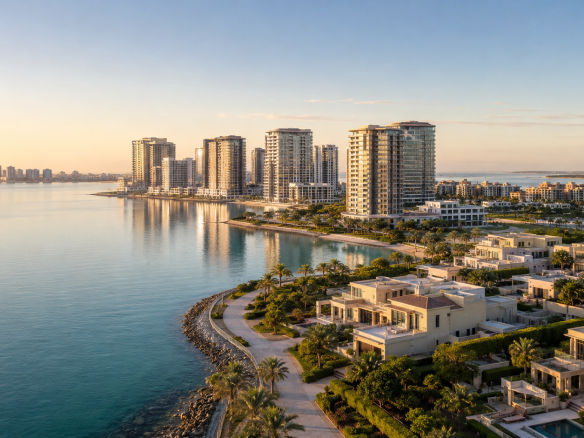
Abu Dhabi provides several examples of destination-led development. Saadiyat Island combines luxury residences with beaches, education and major cultural institutions. Yas Island integrates homes with entertainment, hospitality, retail and leisure. Other emerging communities are being shaped around wellness, sustainability and waterfront living.
Dubai follows a similarly ambitious approach, with districts designed around commerce, tourism, lifestyle, logistics, technology and international connectivity.
Not every master plan develops at the same speed, and investors must distinguish confirmed projects from early proposals. Nevertheless, the UAE’s long-term planning culture gives property buyers something valuable: the ability to invest in places connected to a wider vision.
2. Abu Dhabi and Dubai Offer Different Investment Personalities
There is no single “UAE real estate market.” Each emirate, community and property segment behaves differently.
This diversity is one of the market’s strengths.
Dubai is often associated with:
- High international visibility
- Broad property selection
- Active transaction volumes
- Tourism and short-term rental demand
- Global business connectivity
- Frequent off-plan launches
- A large and diverse tenant population
Abu Dhabi is often associated with:
- Long-term economic stability
- Carefully planned communities
- Strong family and professional demand
- Cultural and institutional development
- Premium waterfront destinations
- A more measured development profile
- Growing international investment access
Neither market is automatically better. The right choice depends on the investor’s objectives.
An investor seeking broad resale activity and international exposure may focus on selected Dubai communities. Another seeking a luxury residence in a lower-density cultural setting may prefer Saadiyat Island. A family-oriented investor may prioritise villas and townhouses near schools, while an income investor may focus on efficient apartments in established employment corridors.
The ability to choose between different market personalities allows investors to build strategies aligned with their risk tolerance, budget and holding period.
That variety is one reason UAE property remains consistently interesting.
3. Real Estate Is Connected to a Global Lifestyle
The UAE attracts people from around the world for employment, entrepreneurship, education, lifestyle and investment.
That international character directly affects real estate.
Property demand does not come from one narrow demographic. Depending on the community, buyers and tenants may include:
- UAE nationals
- Long-term expatriate residents
- International professionals
- Entrepreneurs and business owners
- Families relocating to the region
- Overseas investors
- Luxury second-home buyers
- Retirees
- Students and academic professionals
- Tourism and hospitality customers
A diverse demand base can create opportunities across multiple property types and price categories.
Luxury waterfront residences may attract international buyers seeking lifestyle and capital preservation. Apartments near commercial centres may appeal to professionals. Family communities with parks and schools may attract long-term tenants. Branded residences may serve buyers who value service and global recognition.
This does not mean every project will attract every audience. Successful investing requires identifying the specific customer for a property.
The question is not simply, “Will people want to live in the UAE?” It is, “Which people will want this particular property, and why?”
When a property has a clear answer to that question, it becomes easier to understand its potential rental and resale demand.
4. The Market Offers Multiple Ways to Invest
Another reason we love UAE real estate is the breadth of available investment formats.
Investors can choose between:
- Completed apartments
- Off-plan residences
- Villas and townhouses
- Luxury waterfront homes
- Branded residences
- Commercial property
- Long-term rental investments
- Holiday-home opportunities
- Renovation projects
- Land or development opportunities
Even within one category, the strategies can differ significantly.
A ready property can provide immediate visibility over its condition, surrounding community and current rental market. It may also begin producing income shortly after completion of the purchase.
An off-plan property can offer staged payments and access to a new development at an earlier phase. However, it also introduces construction, completion, supply and future-valuation risks.
A villa may offer long-term family appeal and land-related scarcity but require a larger capital commitment and greater maintenance. A smaller apartment may offer a broader rental audience and a more accessible entry price, but face greater competition from similar units.
This variety allows an investor to select the structure that suits their financial position rather than forcing every buyer into the same model.
The market’s flexibility is valuable—but only when the strategy is clear.
5. Quality of Life Supports Property Demand
People do not rent or purchase a home based only on yield calculations. They choose places where they can imagine living comfortably.
The UAE offers many lifestyle qualities that support residential demand:
- Modern infrastructure
- High-quality roads and airports
- International schools
- Advanced healthcare
- Beaches and waterfronts
- Retail and dining
- Cultural attractions
- Sports and entertainment
- Family-oriented communities
- Professional opportunities
- A high standard of service
- A strong sense of personal security
These factors help explain why certain communities become more than investment locations. They become destinations.
Saadiyat Island, for example, appeals to buyers who value culture, nature, beaches and refined residential environments. Yas Island serves a different lifestyle, combining entertainment, leisure and family living. In Dubai, communities can range from high-energy urban districts to golf estates, beachfront neighbourhoods and suburban family destinations.
Lifestyle should not be treated as a vague marketing concept. It should be analysed as a demand driver.
Ask:
- What daily experience does the community offer?
- Who will value that experience?
- Is the lifestyle already established or still developing?
- Are the facilities accessible and well managed?
- Does the property genuinely benefit from the destination?
A property connected to a strong lifestyle proposition may achieve better occupancy, stronger tenant retention and more resilient end-user demand.
6. Regulation and Digital Transparency Continue to Evolve
Investors value markets where information can be verified and transactions are supported by clear procedures.
Abu Dhabi and Dubai have continued developing regulatory systems and digital property services intended to make the market more transparent and accessible.
Investors can use official platforms to verify or review information relating to:
- Properties
- Projects
- Developers
- Brokers
- Advertising permits
- Transaction records
- Rental data
- Ownership documents
- Escrow accounts
- Construction progress
- Service charges
In Abu Dhabi, the Abu Dhabi Real Estate Centre, DARI and the Madhmoun system support different parts of the property ecosystem.
In Dubai, the Dubai Land Department and Dubai REST provide access to real estate services, data and project information.
No digital platform removes the need for legal and professional due diligence. Documents must still be reviewed carefully, and investors must ensure payments are made through the correct authorised channels.
Nevertheless, the ability to consult official sources strengthens investor confidence. It also makes it easier to challenge unsupported claims.
A sophisticated market is not one in which risk disappears. It is one in which investors have better tools for identifying and managing risk.
7. Income and Appreciation Can Be Considered Together
Real estate can potentially create returns through two main channels:
- Rental income
- Capital appreciation
This combination is an important part of the asset class’s appeal.
A completed property may generate rent while the investor holds it. At the same time, the property may appreciate if the community matures, demand strengthens, infrastructure improves or the asset becomes scarcer.
However, both components must be analysed realistically.
An advertised gross yield does not account for:
- Service charges
- Maintenance
- Management fees
- Vacancy
- Financing costs
- Furnishing
- Repairs
- Transaction expenses
Similarly, appreciation should never be treated as guaranteed. A desirable master plan or prestigious brand may support future value, but entry price and competing supply remain critical.
The most resilient investments do not rely entirely on an optimistic resale price. They have a clear reason to remain useful and desirable during the holding period.
Investors should ask:
- Can the property produce acceptable income at current market rents?
- Is the purchase price supported by comparable evidence?
- What could improve future demand?
- How much similar supply is coming?
- Can I hold the property if prices temporarily weaken?
- Who is the likely future buyer?
When income and long-term value are examined together, investors gain a more complete view of performance.
8. Strong Communities Can Create Emotional and Financial Value
The best real estate often produces both practical and emotional attachment.
A tenant who enjoys the community may renew for several years. A family who builds a life around local schools and amenities may be reluctant to leave. An owner who values a particular view, beach or neighbourhood may accept a premium to remain there.
That emotional connection can translate into financial value through:
- Tenant retention
- Lower vacancy
- Stronger end-user demand
- Greater willingness to maintain the property
- More stable community reputation
- Premiums for scarce locations
This is especially important in luxury real estate.
At the premium end of the market, buyers are not purchasing square footage alone. They may be purchasing privacy, identity, architecture, service, exclusivity and a particular relationship with the city.
Yet emotional value must still be supported by quality. A luxury label cannot compensate indefinitely for weak management, poor construction or excessive supply.
The strongest communities create attachment because they consistently deliver the experience they promise.
Investors should therefore examine not only the sales brochure but also how completed communities are maintained and experienced.
9. Real Estate Can Serve Both Personal and Financial Objectives
Some investments are purely financial. Property can be more flexible.
An individual may purchase a property to:
- Generate rent today
- Use it personally in the future
- Establish a regional base
- Provide housing for family
- Diversify wealth
- Create a legacy asset
- Support a future relocation
- Combine holiday use with investment
- Hold capital in a tangible asset
This flexibility is particularly relevant to international investors whose relationship with the UAE may evolve over time.
A property initially acquired as a rental investment may later become a second home. A family residence may eventually be leased. A long-term investment may become part of an estate plan.
However, mixed objectives require careful prioritisation.
The ideal personal residence is not always the strongest rental investment. A property chosen for emotional reasons may have features the wider market will not pay for. Similarly, the highest-yielding unit may not suit the owner’s future lifestyle.
Before purchasing, rank your objectives.
Is income the priority? Personal use? Capital preservation? Future relocation? Appreciation?
A property can serve several purposes, but the investor should know which purpose leads the decision.
10. The Market Rewards Knowledge and Disciplined Advice
Perhaps the most compelling aspect of UAE real estate is that informed investors can create an advantage.
Attractive opportunities are not identified solely through access to listings. They are identified through better interpretation.
An experienced investor or adviser examines:
- Achieved transaction prices
- Genuine rental evidence
- Developer execution
- Building management
- Service charges
- Payment-plan structure
- Future supply
- Layout quality
- View protection
- Tenant profile
- Resale competition
- Exit liquidity
Two properties may appear almost identical online, yet one may offer a substantially stronger investment case.
The difference may be found in a more efficient layout, a lower annual cost, a better view, a more established building, a protected position or a more realistic entry price.
This is why advisory quality matters.
A professional real estate consultant should do more than promote inventory. The consultant should help the client define the objective, compare alternatives, challenge assumptions and understand the risks behind every projected return.
The best advice is not always to purchase immediately. Sometimes the correct recommendation is to negotiate, select another unit, reconsider the financing structure or wait for a more suitable opportunity.
The market rewards decisiveness, but it rewards informed decisiveness most.
What We Do Not Love About Real Estate
A credible discussion should also acknowledge the frustrations and risks.
Real estate can involve:
- High transaction costs
- Limited short-term liquidity
- Maintenance responsibilities
- Market cycles
- Vacancy
- Delayed construction
- Changing supply conditions
- Complex documentation
- Financing risk
- Emotional decision-making
- Overly optimistic marketing
These disadvantages do not make property a poor asset. They mean it must be approached professionally.
An investor should maintain sufficient liquidity outside the property, prepare for unexpected expenses and avoid depending on an immediate resale.
For off-plan property, developer history, project registration, escrow arrangements and realistic completion assumptions require careful review.
For ready property, physical inspection, building condition, service charges, tenancy status and title documentation become central.
Real estate deserves enthusiasm, but it also demands patience.
How to Choose a UAE Property You Will Still Value in Ten Years
A long-term investment decision can be tested through several questions:
Does the property serve a genuine need?
Properties that solve a clear housing or lifestyle requirement are generally easier to understand than those dependent mainly on promotional attention.
Is the location connected to employment, lifestyle or infrastructure?
Demand is strengthened when a community has a convincing reason for people to live there.
Is the property differentiated?
View, layout, privacy, quality and position can help a property compete against future supply.
Is the total cost sustainable?
Include acquisition charges, financing, service charges, maintenance, management and vacancy.
Can the property survive a weaker market?
A resilient investment should not require continuous price growth to remain financially manageable.
Is there a credible future buyer?
Think about the exit audience before purchasing.
Does the investment match your actual objective?
Do not select an asset designed for short-term speculation if your priority is stable income or long-term family use.
Why Abu Dhabi and Dubai Continue to Inspire Confidence
Abu Dhabi and Dubai are compelling because they are continuously evolving.
Their property markets reflect wider ambitions in business, tourism, culture, technology, education and quality of life. Investors are not simply selecting buildings; they are choosing positions within cities that continue to develop their global relevance.
Dubai offers energy, international visibility and remarkable variety. Abu Dhabi offers depth, planning, institutional strength and an increasingly sophisticated luxury market.
Together, they provide investors with a wide spectrum of opportunities.
The attraction is not that every property will succeed. It is that informed investors have the ability to choose among diverse communities, strategies and price points within an environment shaped by long-term ambition.
Final Perspective
We love UAE real estate because it is tangible, useful and connected to the future of two globally significant cities.
We love the variety of strategies it offers, the lifestyles its communities create and the possibility of combining financial returns with personal value.
But the strongest appreciation for real estate is not blind enthusiasm. It is informed confidence.
A successful purchase begins by understanding:
- Why the property should remain desirable
- Who will rent or buy it
- What it will cost to own
- How it compares with alternatives
- Which risks could affect performance
- How and when the investment may eventually be exited
When these questions are answered carefully, UAE real estate can become more than an exciting opportunity. It can become a thoughtfully selected part of a long-term wealth strategy.
For a confidential assessment of property opportunities in Abu Dhabi or Dubai, contact Homam Assad Luxury Real Estate Consultant. Every recommendation is shaped around the client’s objectives, budget, holding period and preferred level of risk.
Visit HomamAssad.com to arrange a private consultation.
Disclaimer: This article is intended for general informational purposes and does not constitute legal, tax, mortgage or financial advice. Property prices, fees, regulations, rental conditions and investment performance can change. Investors should conduct independent due diligence and obtain appropriate professional advice before completing any transaction.



Join The Discussion